If you are ordering custom shirts, there is a good chance you have heard the terms DTF and DTG. Both are digital printing methods capable of producing detailed, full color artwork, but they do not create the same finished product.
One of the questions we hear at Satellite PrintLab is simple:
Which one looks better?
The answer is not that one printing method is always better than the other. DTF and DTG have different strengths, and the quality of the finished shirt depends on the artwork, garment, fabric, color, intended use, and how you want the print to feel.
We use both methods because there are jobs where DTF is clearly the better choice and others where DTG produces exactly the result we want.
Here is how we look at it from a production standpoint.
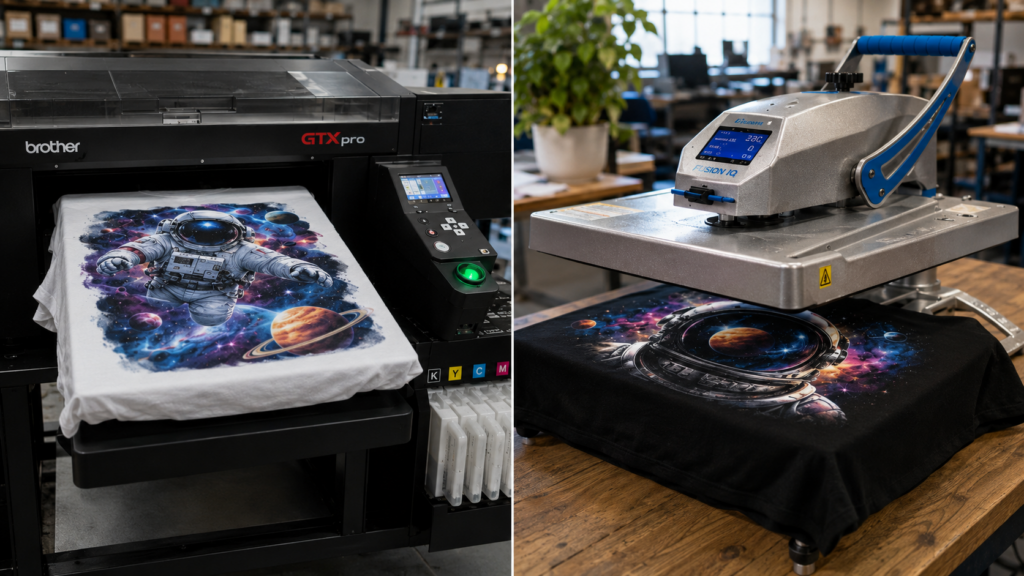
First, What Is DTG Printing?
DTG stands for Direct to Garment.
Think of it as a highly specialized inkjet printer designed for apparel. The shirt is loaded into the printer and textile ink is printed directly onto the fabric. Satellite Printlab uses a water based ink.
There is no transfer sitting between the printer and the garment. The ink becomes part of the printed surface of the shirt.
This is one reason a good DTG print can feel so natural on a quality cotton garment.
Modern DTG equipment is capable of extremely detailed artwork and photographic quality printing without restricting a design to just a few colors.
At Satellite PrintLab, garment selection is a major consideration when we are evaluating a job for DTG.
Smooth, high quality cotton generally provides an excellent printing surface. Brother, one of the major DTG equipment manufacturers, also notes that combed ring spun cotton provides an especially smooth surface for DTG printing because fewer loose fibers interfere with the printed image.
That means the shirt itself matters almost as much as the printer.
What Is DTF Printing?
DTF stands for Direct to Film.
Instead of printing directly onto the garment, the artwork is printed onto a specialized film. An adhesive is applied to the printed transfer, the transfer is cured, and then it is applied to the garment using heat and pressure. We use the exact same ink for our DTF as DTG. This make our process unique.
The result is a highly detailed full color graphic bonded to the surface of the garment. At Satellite Printlab there isn’t that rubbery vinyl feel to our transfers.
This process makes DTF extremely versatile.
We can use DTF on many garments where DTG would either require additional testing or simply would not be our first choice.
That becomes especially important when customers want polyester shirts, blends, performance garments, certain hoodies, workwear, or apparel made from fabrics that are less friendly to water based DTG inks.
For example, polyester does not absorb DTG ink in the same manner as cotton and requires different considerations during production.
This is one of the reasons DTF has become such a useful tool in a modern print shop.
So Which One Has Better Print Quality?
This is where the answer gets interesting.
DTG Can Produce an Extremely Natural Print
When DTG is printed correctly on the right garment, the result can be exceptional.
Detailed artwork, gradients, small color changes, photographs, distressed artwork, and complex illustrations can reproduce beautifully.
More importantly, the print can have a softer relationship with the garment because the ink is being printed directly onto the fabric.
On a premium cotton T-shirt, that can create the type of finished product we want for a retail brand, artist merchandise, or a shirt where the fabric and print should feel like one product rather than two separate materials.
That does not mean every DTG print automatically feels soft.
Pretreatment, ink levels, curing, artwork preparation, garment construction, and even the fibers in the shirt all affect the final result.
Good DTG printing is a production process, not simply pressing the Print button.
DTF Usually Produces a More Consistent Surface
DTF has a different advantage.
Because the image is produced as a transfer and then applied to the garment, we can create a very consistent image across a wider variety of fabrics.
Colors can look extremely vibrant. Fine details reproduce well. Solid areas can be bold and clean.
This can make DTF particularly effective for colorful logos, illustrations, sponsor graphics, event merchandise, uniforms, and artwork that needs to stay visually consistent across several garment types.
Imagine an order that includes:
Cotton T-shirts
Polyester performance shirts
Hoodies
Work shirts
The same artwork may need to appear on every piece.
That is the kind of project where DTF can become very attractive.
What About the Feel of the Print?
This is one of the biggest differences customers notice.
A DTG print is ink printed directly into and onto the textile fibers.
A DTF graphic is a transfer bonded to the garment.
Because of that, DTF generally has more of a noticeable surface feel, especially when the artwork contains a large solid printed area. This is where our water based prints differ. In general our prints are much softer. The Brother inks don’t have the glycols or glycerin in the ink, so you don’t get that vinyl feel.
That does not necessarily make it uncomfortable.
A well produced DTF transfer can be thin, flexible, and very wearable. But if you print a large 12 inch solid rectangle across the front of a shirt, you will feel it differently than a DTG print of the same artwork.
Artwork design matters tremendously here.
A DTF design with open space between the elements can feel dramatically different from one giant solid block of ink.
This is why we look at the actual artwork before recommending a printing process.
What About Color Vibrancy?
DTF often has an advantage when a customer wants extremely bold color on a variety of garment colors and materials.
The white layer beneath the artwork creates a strong foundation for the colors above it.
DTG can also produce excellent vibrant color, particularly when the garment, pretreatment, printer settings, ink levels, and curing process are properly matched.
But DTG interacts more directly with the garment underneath it.
That means two different shirts can sometimes produce noticeably different results even when the same digital artwork is used.
This is not necessarily a flaw. It is simply part of printing directly onto textiles.
What About Durability?
A properly produced print using either technology should be capable of creating a durable garment.
For DTG specifically, Brother reports that properly cured GTX prints have wash durability similar to properly cured water based screen printing and reports an AATCC durability rating of 4.0 or greater for its textile inks.
But there is an important phrase there:
Properly produced.
The printer or transfer technology alone does not determine durability.
Curing temperature, time, pressure, pretreatment, transfer application, garment material, ink chemistry, and washing habits all matter.
That is one reason choosing an experienced print shop matters.
The equipment is only part of the equation.
When We Would Choose DTG
At Satellite PrintLab, we would strongly consider DTG when the project involves:
Premium cotton T-shirts
Detailed or photographic artwork
Retail quality apparel
Artwork where a softer printed feel is important
Designs with gradients and subtle color transitions
Short and medium production runs
Premium merchandise where the garment itself is a major part of the product
DTG is especially impressive when great artwork is paired with a smooth, high quality shirt.
When We Would Choose DTF
We would strongly consider DTF when the project involves:
Odd printing locations
Ribbed material
Performance apparel
Multiple garment materials in the same order
Bright full color logos and illustrations
Uniforms and workwear
Hoodies and specialty garments
Artwork that needs consistent color across several product types
Orders where flexibility is more important than using one specific printing process
DTF gives us tremendous freedom when the customer’s merchandise program extends beyond a basic cotton T-shirt.
The Shirt Matters More Than Most People Realize
Customers sometimes spend hours perfecting their artwork and almost no time thinking about the blank garment.
That is backwards.
The same design printed on a budget open end cotton shirt and a premium combed ring spun cotton shirt can look and feel noticeably different.
Fabric texture affects detail.
Fiber quality affects the printed surface.
Fabric composition affects how ink interacts with the garment.
Garment color affects the printing process.
The best printing method cannot completely overcome the wrong product choice.
That is why we spend time helping customers choose the garment before production begins.
DTF vs. DTG: Our Recommendation
If someone asks us:
“Which is better, DTF or DTG?”
Our answer is:
Better for what?
If we want an incredibly natural print on a premium cotton T-shirt, DTG may be our first choice.
If we need bold, consistent artwork across multiple fabrics and garment types, DTF may be the better production method.
The goal should never be to force every order through the same printing process.
The goal is to choose the process that produces the best finished product for that particular project.
That is the advantage of working with a print shop that offers multiple decoration methods.
We can look at the artwork, garment, quantity, application, and how the shirt will actually be used before recommending how it should be printed.
If you have a custom apparel project and are unsure whether DTF or DTG printing makes more sense, send Satellite PrintLab the artwork and project details. We can help you choose the garment and printing method that will give you the finished product you are actually looking for.